13 February 2014

Rattled and Ready

There are certain aspects of cruising that I fear but know with certainty that I'll have to face. These aspects are all related to the potential for damage to the boat or, worse, injury to the crew. From stubbed toes after kicking deck hardware through sinking and drowning, everything in between may fall under one of these fear-inducing scenarios.

Last night we were expecting squalls packing 30- to 35-knot winds and some rain. The probability of damage or injury in those conditions is low, assuming you do your due diligence. When it comes to dealing with fear I choose to take a systematic and over-engineered approach, and that's my due diligence. Fear, of course, needs to be addressed or it becomes a driving force in decision making.

The first logical step for me in last night's conditions, is to find a well protected harbor with good holding. Things worked out well in that regard, since we're moored in a harbor that has 360-degree protection. Also, the moorings here are designed to hold boats in place through hurricane season. Taia is currently moored to a chunk of cement that weighs 2 tons. The chain attached to the cement block is big, much bigger than our anchor chain. So I was satisfied with the level of protection and holding.

One thing I wasn't happy about but could not possibly change is the fact that this harbor is packed with boats. Especially yesterday, since the weather forecast looked so blustery. The harbor is like a can of sardines, packed tight with boats swinging on their moorings, some times as close as 3 meters from each other, depending on the swing angle. If a single mooring goes, the loose boat will certainly scrape its neighbors' hulls and appendages. Time to systematically over-engineer prevention.

Yesterday afternoon I dove and inspected the chain, shackles and swivel on the mooring. One of the shackles didn't look strong enough to hold an aircraft carrier hanging from a bridge, so I loosely joined the mooring lines and the chain with a few wraps of 3/8" dock line. If the shackle parted, the line might save us from blowing away in the wind and into other boats.

Up came the kayak after spending the last couple of weeks floating behind Taia. Anything that was loose on deck was brought into the protection of the cockpit enclosure or the cabin. I checked the running rigging, making sure no lines could come undone; I made sure the jib was properly furled with the sheets wrapped around the sail a couple of times; I put the Bahamian courtesy flag into the mains'l bag and put away our Canadian flag. Finally, I moved the dinghy from its normal place beside Taia to behind it; that way it wouldn't rub against the hull when the chop picked up.

Before going to bed Natalia and I put up and zippered all the panels of the cockpit enclosure. And so we went to bed and read and slept. Until around midnight, that is, when the rain started its meek and harmless sprinkle. Half an hour later both Natalia and I were in the cockpit with grave expressions on our faces.

The scene was dark and loud, punctuated by lightning. With every flash of lightning, we could see neighboring boats swinging and rolling in the chop around us. After each flash we saw pitch black and could only hear thunder and wind while Taia kept bucking her mooring lines. The boat heeled when gusts attacked it from slightly off the bow. The cockpit enclosure, with its soft canvas, groaned and flapped like it might detach itself from the boat any second.

I was rattled. So was Natalia. The kids slept, although Camila said this morning she was awake for a while.

As soon as the wind came down to 20 knots I went out on deck to inspect the mooring lines. Everything was perfect. I took advantage of the lull to open the deck fills to the water tanks, although it hasn't really rained that much.

This all may sound like we were in the middle of a hurricane, but we weren't. The wind speed instrument showed sustained winds of 30+ knots, with gusts in the mid 30's. So it wasn't that much wind, really. And the chop was minimal, since the harbor is so well protected. But it was the first time we saw this much wind while on the boat. Throughout the worst of it, I kept repeating to myself that we had done our due diligence and that cruisers talk about 40-knot winds at anchor like it's a common occurrence.

Of course, nothing bad happened. Thirty minutes later the wind came back down to 20 knots and we went back to bed. We slept peacefully through the rest of the night. The wind picked up again today, but only up to 28 knots or so. The squalls will continue through the rest of the day. But now we're not rattled in the least. Also, the fact that there's plenty of light to see around us makes any fears seem unfounded and silly.

Now, about lightning: lightning makes me shit my pants. Every time there's lightning I'm reminded of a scene from The Thin Red Line. In it, an officer walks around a group of cowering infantrymen in the middle of an artillery barrage. He tells them there's no point in moving around, as luck is the only determinant factor in who will live through the barrage. That's the kind of fear lightning induces in me. When there's a lot of it, I shit my pants and then try to calm down. And when the fireworks display is done I wash my pants. Then the sun comes out and I go swimming and smile again.

Our Austrian neighbors during one of the squalls today. The weather doesn't look threatening, does it?

11 February 2014

Yet another daily routine

It's been two weeks since we got to Man-O-War. Since then, we have fallen into an easy routine. We wake up relatively early for our standards, somewhere between 6.30 and 7.30. We all have breakfast together and then we take the kids to school, which takes about 3 minutes with the dinghy plus another 5 minutes of walking to the school.

Camila and Matias in front of the school.
At noon, the kids have their lunch break. We bring them lunch at school and talk a bit while they quickly munch their food so they can go play for a few minutes before going back to class.

At 3 pm, the school finishes and we pick them up once again. We come to the boat, swim around a bit, have a snack, they do their homework and then have dinner. On weekends, we usually spend the day at the beach and then have a movie night aboard.

While the kids are in school Ernesto and I have some much needed couple time. Something that is new for us since we starting cruising. The boat is quiet and much bigger than usual with just the two of us aboard. During this time, we listen to the cruisers' net on the VHF and drink mate, we stroll through the city or the beach, we read, we go snorkeling or grocery shopping and also take care of any boat projects that may have accumulated.
Snorkeling on the Attlantic side of Man-O-War. I call this fish Dory, I'm still looking for Nemo.

The beach where we go on the weekends, called the Low Place. On the right of the picture is the Atlantic Ocean. On the left, the Sea of Abaco.


It's been very relaxing and enjoyable. The kids are really happy and enjoy going to school. Camila only complained once, wishing school could start after 10. They are already seeing differences with Canada and, especially, how school was in Canada. And that's exactly what we want them to experience. To see life, other people, other countries, other beliefs and ways of living, and learn to value what they have.

Life in a small island of about 300 inhabitants is different to what we are used to. The only bank on the cay is open one day a week, for half a day. The cell phone company opens one day a month, for half a day. The ferry with the food comes every Thursday to stock up the local supermarket. Laundry costs $10 per wash/dry compared to the $3 we used to pay in the USA.

In Matias' own words, we're all happy in the Bahamas:
"We are happy in the Bahamas"

01 February 2014

Insufficient Senses

We're here. We've made it. We're in the Bahamas. This particular goal is achieved and now we're rejoicing, rapturous. This place, everything it means for us as a family and me as an individual, is heavenly.

The weather window for the crossing was good. As is becoming a family tradition, we picked a weather window that necessitated a healthy amount of diesel and produced minimal worry, stress, and seasickness. Anchor up in Lake Worth last Sunday at 0525, anchor down on the east side of Mangrove Cay that night at 1925.

With a cruising speed of 6 knots, we had to do some old-fashioned navigation work to compensate for the set of the Gulf Stream. We pointed our bow to a point 18 miles south of Memory Rock, the Bahamian landmark where we wanted to enter the Little Bahama Bank. The course to follow was 110 degrees magnetic. The autopilot had no trouble maintaining the course and it was interesting to see the 55-mile-long letter 'S' representing our track. As the autopilot steered its S, we tried to trim the sails to maximise our speed. Although the wind was fickle, we were able to increase our velocity made good by a good knot or knot-and-a-half.
Having an argument with the spinnaker pole. The pole won this time.
 While the Gulf Stream cradled us northward and the engine and sails eastward, we couldn't help but notice the changes in water temperature. In Lake Worth the water was at around 26 degrees Celsius. In the Stream we saw close to 31 degrees! The temperature of the water was a harbinger of hours of snorkeling and swimming and beach-going.

At around 1300 we entered the Little Bahama Bank. Immediately the air temperature dropped a degree or two. Then the water temperature started dropping as well; from 30 degrees in the Stream to 24 degrees in the bank. With some disappointment, we continued our path east. The color of the water, its perfect clarity, the shadow of the boat sliding over the sandy bottom no more than 4 meters under the surface; everything we saw made up for the relatively low water temperature.
Blue and white.
Our shadow is properly sewed to our keel.
As we entered the bank our senses were stimulated to perfection. We were all mesmerized by our blue surroundings. Although the wind abandoned us, we decided to imbue ourselves with the environment by shutting off the engine. We sailed at 1 or 2 knots for a few hours. There was little talk aboard as we put all our energy into staring and enjoying. I wish we had more senses that would allow us to feel more and remember better.
Clear and flat Little Bahama Bank.
The Sun brought us back to reality as it started going down. The forecast had light and variable winds for that night, but we still wanted to anchor close to land, not just to get some protection in case it picked up, but also to make sure we wouldn't be anchored along someone else's track. With the engine roaring again, we made it to Mangrove Cay by 1900. We had another 75 miles to cover the next day.
Momma duck and her ducklings in the Sea of Abaco.
Dawn found the bank in a flat calm. No wind. Smooth surface. And we motored east. As we started rounding the northeast corner of Little Abaco Island, the wind picked up from the south at around 10 knots. With that kind of wind and no waves, we had a glorious sail towards Green Turtle Cay, where we dropped anchor at 1630. Throughout the afternoon we continued to be mesmerized by the water and the bottom of the bank. I continued to wish for more senses.
A little R&R for the crew after 2 days at sea.
The next morning I put on my Sunday best and motored into New Plymouth, the settlement on Green Turtle Cay, to clear customs and immigration. My first landfall in the Bahamas. The process of clearing in is quite simple and didn't take longer than 30 minutes. After that I went back to Taia and we all went for a swim before weighing anchor and sailing to Man-O-War Cay.
New Plymouth at dawn.

Anchor chain in Green Turtle Cay.
There's a shoaling between Green Turtle and Man-O-War that requires deeper draft boats like ours to leave the Sea of Abaco into the Atlantic Ocean for 2 or 3 miles. This is done by transiting Whale Cay Cut, or the Whale for short. This cut can be challenging when there's a north easterly swell. After 2 days of very little wind, the swell was gentle and lulling. The wind died again after we crossed the Whale; on came the engine.
Difficult Whale crossing?
As we approached Man-O-War, I started hailing Hold Fast on the VHF. They know the area well and were going to guide us through the tight channel that enters the harbour. As is their custom, they went out of their way to help us. They came out on their dinghy to meet us when we were still a couple of miles away. Then they waited for us at the entrance and we followed them in. Myron and Dena are our guardian angels, always ready to help and share their knowledge and experience.

And here we are, comfortably moored right next to Hold Fast. The kids have started going to school. Natalia and I get to be on our own on the boat or around the cay for a few hours a day. We've fallen into a comfortable routine and we are loving every second of it. I still wish I had more senses to take all of this in.

25 January 2014

Gulf Stream Crossing

We're going to the Bahamas tomorrow!

The plan is to weigh anchor at 5 am. It's 60 miles from Lake Worth, Florida, to the western edge of the Little Bahama Bank. After getting onto the bank, we'll sail another 40 miles to Great Sale Cay and spend the night there.

As soon as we lose connectivity with the Florida cell towers we'll be living dangerously and recklessly: we won't have an internet connection! It could be a few days before we find one.

The forecast is benign, almost docile. It should be an easy crossing.

Catch you on the flip side!

15 January 2014

One Thousand Easy and Convenient Miles

Somewhere between Vero Beach and Fort Pierce we counted our one-thousandth nautical mile since we left Solomons Island back in October of 2013. As we congratulated each other on this milestone (pun totally intended), the good ship Taia scoffed contemptuously and kept slicing through the murky waters of the ICW. In her 33 years, she is likely to have seen many more thousands of miles slowly pass under her keel.

Quite satisfied with ourselves for this nautical achievement, Natalia and I celebrated with a smile and a nod at each other. The kids, deeply enthralled by their daily allowance of iPad consumption, graciously ignored the captain's chipper announcement and resumed their entertainment 3 milliseconds and 1 empty stare later. Then we proceeded to anchor less than a mile south of the Fort Pierce inlet. The sun congratulated us by setting in an explosion of orange and purple.

Our week in Vero Beach seemed like a couple of days. We got a lot of hoarding... sorry, provisioning, done. Being on the verge of crossing the Gulf Stream to get to the Bahamas, we wanted to be sure we had a lot of everything we think we might need. As difficult as it is for me to admit to this, here it goes: I'm afraid to leave the reassuring convenience of having everything under the sun available for purchase at a reasonable price (Dear Amazon: I love you!). I hope to one day look back at these frenzied shopping sprees and laugh at myself for having been so ludicrously addicted to instant availability of everything. (That said, I'm still looking for automatic transmission fluid, so if you know where to find it close to downtown West Palm Beach, please give me a shout. And remember, it has to be both convenient to get and cheap!)

We had planned on doing another offshore hop from Fort Pierce to Lake Worth, but, hardy and salty as we are after our first 1000 nautical miles, we decided not to face southerly winds and the north-setting Gulf Stream while trying to go south. Instead, we stayed on the ICW and motored comfortably to the St. Lucie River, which empties into the Atlantic Ocean through the St. Lucie inlet.
Swimming in the St. Lucie River
After arriving at St. Lucie, the weather forecast announced south-westerly winds for the next day. With these slightly favourable winds, we decided to venture offshore for an easy 30 miles to Lake Worth inlet. And so we did. We had our best sail since the Chesapeake. It was a lively 25-mile beat with 3- to 4-foot waves and 15- to 20-knot winds. Not very comfortable, but the fact that we were sailing, not motoring, in those conditions, made me extremely proud of the crew.

The city of West Palm Beach is located three miles south of Lake Worth inlet. The anchorage, right next to downtown, is wonderful: protected, with good holding, and with 2 newly-built public floating docks that don't chew up inflatable dinghies. This town has been a very pleasant surprise.

We put high value in a good anchorage, and this one has the additional perk of a beautiful locale. Downtown West Palm Beach doesn't boast the typical modern architecture of steel and glass. The buildings are modern but in an art deco style reminiscent of Miami Beach. Everything is clean, pretty, and colorful.

West Palm Beach will be our home for the next few days, while we wait for a good weather window to cross the Gulf Stream and enter the Little Bahama Bank. The water's getting warmer and clearer, and the crew is ready for more of that.

05 January 2014

From St. Augustine to Vero Beach

I was surprised when we got to St. Augustine. Yes, we heard that it was beautiful from different people but I didn't expect such a pretty and touristy little city.

St. Augustine is the oldest city in the United States, founded by the Spanish in 1565. For centuries, Spanish, French and British people fought against each other to settle in these lands. As such, the city has a lot of history. Castillo de San Marcos, the fort used to protect the city from invaders, is still there and a great place to visit. This is one of the reasons I'm doing this adventure. I love to travel and learn the local history. There's nothing, in my mind, that compares to that.

After 2 days in St. Augustine we headed south again. But the weather didn't cooperate this time.  We had a series of 3 cities we wanted to anchor and visit but were unable to do so due to the lack of protected anchorages.

We got to Vero Beach yesterday and will stay here for a few days. Today we had a great day at the beach.


Entering St. Augustine harbor.

Castillo de San Marcos.

Walking around the city.

Pirate attack!!! A re-enactment of a pirate boat attacking another sailboat. You should have seen Matias' face :)

Taking a break. Castillo de San Marco at the back.

Oldest school building.

A Spanish galeón that is sailing around the world. They got to St. Augustine a few days before us and were preparing the boat for visits.

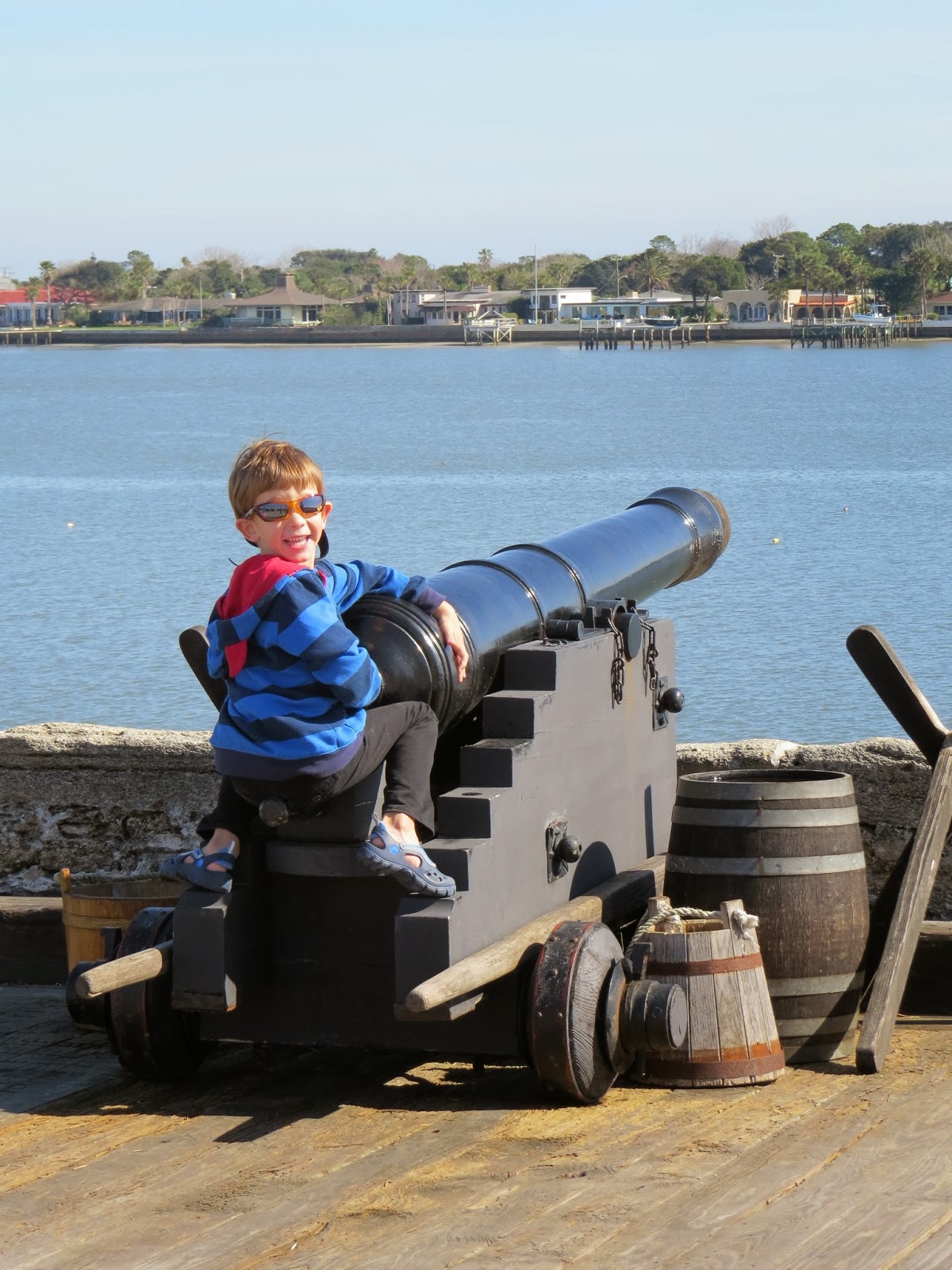
Matias ready to defend the city! He's riding the cannon :P

Cannon shooting at Castillo de San Marcos.

Vero Beach


27 December 2013

New Friends and a Floridian Solstice

We came to Jacksonville looking for an affordable marina where we could install an arch and solar panels, as well as perform some other routine maintenance on the boat. A trip to Disney was also part of the plan while in Jacksonville. The right marina wasn't difficult to find, the trip to Disney was a blast, and the projects got underway as soon as the right materials were delivered. What we didn't imagine or plan for was the number of friends we would make.

The Ortega Yacht Club Marina proved to be a great community. We were especially fortunate to meet and befriend Dena, Shari, Myron, Fred, and Paul. This great group of people not only gave us a warm social context for the last 6 weeks, but also helped quite a bit with the most complex project we've done on the boat.

The arch was delivered as a collection of aluminum tubes shaped and cut to roughly fit. It didn't take much effort to assemble it and park it in its planned position. Enter the Devil to take care of the details and make the experience interesting... the job took 6 days.

The captain hanging from the newly-installed arch. Those bolts can take a lot tension!
Then came the solar panels. Myron answered a few questions that helped me understand the electrical connections between panels, charge controller, and batteries; the connections themselves were easy. I'd always known the more complex part of the project would be to mount the modules on the arch.

Lucky me, I had 3 experienced engineers watching over my shoulder. Fred, Myron, and Paul were constantly ready to answer questions and lend a hand. One afternoon, when the design I had in my head didn't quite agree with the real measurements I was taking, Paul came around shrouded in a halo of kindness. He offered to drive me to his place and help me drill a few holes using his drill press. That made the job of bolting panels, mounts, and arch much easier.
Natalia unpacking the 2 solar panels. 270 Watts each!

Ernesto (left, squatting) working under Myron's (centre) and Fred's supervision.
Lining up the mounting structure on the arch.
Hurry up! The Sun is blasting those panels and their cables remain unconnected; wasted amps...
One morning Paul, who is the marina's resident diver, was cleaning the bottom of a 17-foot sailboat. Peter, the boat's owner, was standing on the dock while Paul worked. I happened to walk by on my way to I-don't-remember-where-so-it-must-have-been-of-utmost-importance, when Peter started the typical boater conversation. Much like parents in a playground, boaters stand around on the docks and talk about their babies. Within minutes, Peter had offered to drive us around if we needed supplies, and invited us to a meal in his place.

Peter's casual invitation turned out to be a full day affair. He picked us up at the dock in his power boat, whence we went to his house on the Ortega River. Peter's wife, Laura, and his son, Zac, were equally welcoming and interesting. After a few burgers and some excellent Casillero del Diablo cabernet sauvignon, we piled up on Peter's power boat again, this time to go tubing. Fun, fun, fun.
Tubing in the Ortega River.
Matias at the helm on Peter's boat.
The winter solstice is now past. The solar panels are quietly and tirelessly producing most of the electricity we consume. We are thankful to Ra for exciting the electrons in just the right manner. And we are thankful to our new friends for their company, their kindness, their humanity.

01 December 2013

Three-Week Medley

Offshore Hop

The overnight passage we did from Charleston to Cumberland Island was nothing less than glorious. We left Charleston harbor in the dark and hove-to for a couple of hours a few miles from the Saint Mary's inlet to wait for slack water before heading in. Managing a boat at sea is a life-long dream of mine, and this first experience, small and simple as it was, just made me want to spend more time at sea.

We saw dolphins! Many of them! They came to play in our bow wave, swimming back and forth and showing us their wise smiles.
Dolphins approaching Taia's starboard bow
Before dawn, and after leaving Charleston harbor behind, everything was mostly dark. There was some glimmer from the moon filtering through the cloud cover. The sun showed up and with it the water around us changed color from almost black to an enticing greenish blue. The kind of color that makes you want to dive right in.
Atlantic Ocean, 20 miles east of Georgia
During the day life aboard went on uneventful. The grown-ups spent most of their time in the cockpit, tending to the boat, contemplating, talking. The kids watched a couple of movies and roamed around the boat. Whenever dolphins came (and we had several different pods that came to visit) everyone took turns to go up to the bow, where it almost seemed like we could extend our arms and touch them.

The weather forecast called for 20-knot winds starting at midnight, so we tucked in 2 reefs in the main right before sundown. The 20 knots of wind never materialized and we had no more than 8 knots throughout the night. Natalia and I did 3-hour watches.

The main stayed up constantly to counter the swell-induced roll. We didn't see much wind at all, so we motored most of the way. This was our first offshore hop and we wanted to keep it short and simple; floating around like a cork in the swell was outside mission parameters this time.
The sun setting somewhere beyond Georgia
We entered Saint Mary's inlet, the border between Georgia and Florida, 30 hours after weighing anchor in Charleston harbor, and anchored in front of Cumberland Island, Georgia.

It was a great first experience at sea in the dark, one that we will always remember.

Cumberland Island

After squaring the boat away we piled up in the dinghy and rowed ashore, to Cumberland Island and the national park occupying it. The beach on the ocean side seemed like a graveyard for horseshoe skates. There were hundreds of carcasses strewn around in the sand!

The island is famous for its wild horses, and we were lucky enough to spot a glimpse of one.

Trail to the ocean side

Scruffy captain looking full of himself

Cumberland Island wild life

Jacksonville

We knew the weather was expected to deteriorate significantly 2 days after we anchored in Cumberland Island. A cold front was going to bring freezing temperatures and 30- to 40-knot northerly winds. The anchorage in Cumberland Island is well exposed to the north, so we had to move on. Fernandina Beach is right across the river from Cumberland, but we wanted to keep moving south and cover more distance.

After looking at our options, we decided to take advantage of the last day of fair weather and the fact that we were anchored right next to an inlet that is easy to navigate. We decided to do another offshore hop, from Saint Mary's inlet to Saint Johns inlet, in Jacksonville. After a relaxed day at the beach on Cumberland, we went back aboard and got the boat ready to go to sea early the next morning.

It was an easy 9 hours from Cumberland Island to downtown Jacksonville, 6 of those hours at sea, the rest of them motoring up the Saint Johns river.

There's a city-run marina in downtown Jacksonville that is free for up to 3 days. We took good advantage of this unheard-of privilege and shared the 50-slip marina with 1 other boat. Yes, it's free and it was deserted. Very strange.

The cold front came. It was cold. It was windy, angry windy. But we were safely tied up to a sturdy concrete floating dock.

While there, we met Beth and Carmine. Beth is my cousin Ceci's sister-in-law. Carmine is Beth's husband. Excellent people. We had them over for dinner aboard and the next night they took us out to a great restaurant. We're still in Jacksonville and will be seeing them again for sure.
Cold front in Jacksonville

Disney and Kennedy Space Center

While in Jacksonville we took a 5-day road trip to Disney and the Kennedy Space Center. It was lots of fun for everyone.

What's next?

Jacksonville has been home for almost 3 weeks now. We've ordered an aluminum arch and 540 watts' worth of solar panels to attach to the arch. Having these will allow us to spend more time at anchor and use the diesel generator less, maybe not use it at all. As soon as we're done with this project we'll head south again. The Bahamas beckon...

09 November 2013

Momentous Times

It feels like this whole year has been a long string of momentous occasions. We wrapped up our land life by selling our house, our cars, and most of our stuff. We said goodbye to family and friends in Canada. Then we moved aboard, worked hard to get the boat ready, and, finally, after so many years of dreaming and planning, we started cruising. A string of momentous occasions. A long string filled with excitement, stress, sadness, happiness, achievement, frustration, and every emotional colour under the sky.

Today we gathered momentum for another momentous experience: we got ready for our first overnight passage. It's a tiny passage by anyone's standards, only 160 nautical miles. Nothing more than a sneeze for the old salts, this passage will be etched in our memories forever. We are ready to make mistakes and learn from them. Tomorrow we take the first tangible step to becoming mariners.

We picked our weather window carefully. So carefully, in fact, that we'll probably motor the whole way through. There's very little wind in the forecast.

The plan is to exit Charleston harbor at 0600 tomorrow morning and maintain the necessary velocity to arrive at the sea buoy to St. Mary's Inlet no later than 1300 on Tuesday.

Luck, as always, will plays an important role tomorrow. But we've done everything we can to minimise its influence. Everything is stowed in its place, the life raft and ditch bag are easily accessible, jacklines and tethers are ready, spirits are high and anxious at the same time.

You can wish us luck regardless. It's always good to have it as a friend.

Change on the fly

This is a very intense life we're living. Every day is different. We get up when the sun rises, usually in a different place than the day before. We were never early risers but there's something to be said about seeing the sun rise while you lift the anchor and head to a new destination.
Sometimes we have beautiful and easy days of motoring (there are few opportunities to sail on the ICW). Some other days we have very busy and, at times, stressful days.

Every night we plan what we want to do the next day. That involves listening to the weather forecast, planning the route we'll follow, finding out the state of the currents and tides for the area so we know what time we should leave, and, lastly but not less important, finding a well-protected anchorage. But route planning is the easy part! The hardest part is the execution. Some times the day goes as planned, sometimes we need to adapt as we go.

Just the other day, as we were approaching Shallotte Inlet (in southern North Carolina), we started hearing all these calls on VHF Channel 16 from boats running aground in that area. With 6 feet of draft and at low tide, we didn't want to risk it. People were running aground in 5 feet of water! The problem was there weren't many options for dropping anchor before getting to the problematic area. And when I say there weren't many, I mean there was just one tiny place. Fortunately, we were able to get to that place and spend the night there. The next morning we crossed the inlet at high tide and avoided the drama and stress of motoring over skinny water.

Another example of this last-minute change of plans happened a couple of days later when we were on our way to Georgetown, South Carolina. We were a little bit tired so we wanted to have an easy day. We planned to only do 25 nm and get to Georgetown. But as we got closer, the day was so nice that we decided to skip it  and head closer to Charleston. So we quickly planned the routes on the computer, imported them on the chartplotter, and kept going on our merry way.

As we got closer to Charleston the next day we almost had to change plans quickly too. We had to cross a bridge with a charted 65-foot clearance, and our mast rises 62 feet over the water. Most of the bridges have height charts at the bottom, indicating the current clearance. Being extra cautious as we are (enter chicken clucking sounds), we always check the height charts because the tide obviously affects the clearance of a bridge. The problem is, not all the bridges have height charts. And when they do, they're not that big and therefore are not easy to read, even using binoculars. As we were approaching a bridge at high tide, we started rapidly evaluating alternative plans that would avoid crossing that bridge. The height chart seemed to read 61 feet of clearance. We almost turned back to wait for low tide. But after getting a little bit closer we saw the clearance was in fact 63 feet and we were able to cross the bridge without any issues.

I was always used to having to adapt to changes quickly at work. But never have I applied it to my personal life as we're doing now.

Here it's how it goes: We see a bridge far away, and start looking for the clearance charts.


The bridge gets closer and sometimes we still haven't read the charts.

There it is! Couldn't they have make it a tiny bit bigger????
Not mistaking the clearance now as we pass by. But even if we know this, sometimes we pass it thinking at the same time  "OMG! OMG! OMG! We're not going to fit!!!!" It looks tight from down below.